Docker
Docker Sandboxes alternative: a sandbox with no session cap
Docker Sandboxes runs coding agents in microVMs locally, or in its cloud for sessions of up to 24 hours. Platinum runs a microVM until you stop it.
Docker Sandboxes (sbx) runs coding agents in microVMs on a developer's machine, and its cloud runs them in sessions of up to 24 hours. If your agents run for days, or your product gives every user a sandbox it keeps, the Docker Sandboxes alternative is Platinum: a Cloud Hypervisor microVM with no session deadline, at a lower hourly compute price.
What Docker Sandboxes does well#
Each agent gets its own microVM, with its own kernel and Docker daemon. Locally it runs on the operating system's hypervisor (Hypervisor.framework on macOS, Windows Hypervisor Platform, KVM on Linux), it is free, and sbx run claude mounts the current directory. A host-side proxy writes API keys into request headers so they never enter the VM, and nine agents work out of the box, from Claude Code and Codex to Copilot and OpenCode.
Cloud Sandboxes, added in September 2026, run the same microVM on Docker's compute, from the CLI, a web console, a REST API or a TypeScript SDK. A stop keeps memory, and a template can save memory and disk so the next sandbox resumes from it. The cloud needs a Docker Agentic Platform subscription, which Docker labels experimental.
Where the two differ#
| Docker Cloud Sandboxes | Platinum | |
|---|---|---|
| Session | 1 h default, 24 h max; a resume starts a new period | No deadline; runs until stopped |
| Running at once | 10 by default, adjustable | 4 vCPU free, up to 512 vCPU by tier |
| SDKs | TypeScript; REST from any language | Python and TypeScript; REST |
| 1 vCPU, 2 GiB, per hour | $0.07 | $0.054, plus disk |
| 16 vCPU, 32 GiB, per hour | $1.12 | $0.864, plus disk |
| Stopped | Free | Disk only, $0.0526 per GB-month |
Docker's figures are from its announcement, usage guide, limits and signup page, checked November 2026. Platinum's are its rates and tiers.
A stop keeps the running process#
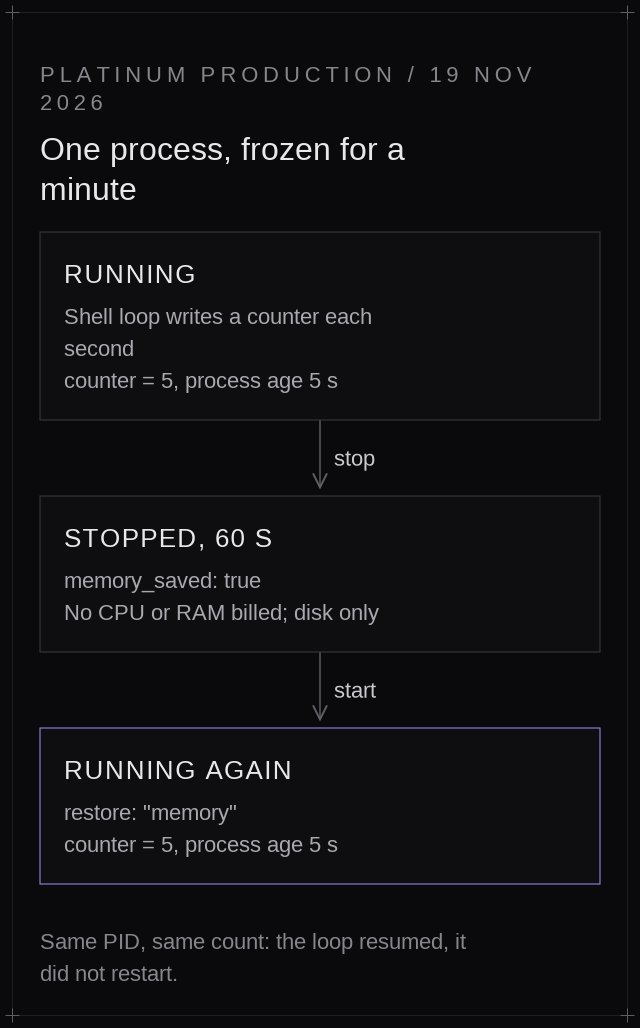
Both products keep memory through a stop. This is Platinum production on 19 November 2026: start a counter, stop the sandbox for a minute, start it again.
import time
from platinum import Platinum

client = Platinum(token="pt_live_…", api_url="https://api.platinum.dev")
sbx = client.sandboxes.create(cpu=1, ram_mb=512, wait_for_running=True)
sbx.process.start("echo $$ > /tmp/pid; i=0; while true; do echo $i > /tmp/c; i=$((i+1)); sleep 1; done")
time.sleep(5)
print(sbx.sh("cat /tmp/c").stdout.strip())

print(sbx.stop(wait_for_stopped=True)["memory_saved"])
time.sleep(60)
print(sbx.start(wait_for_running=True)["restore"])
print(sbx.sh("cat /tmp/c; ps -o etimes= -p $(cat /tmp/pid)").stdout.strip())5
True
memory
5
5Check restore on every start, because some stops save disk only (what a stop saved).
Run the same agents#
Claude Code and Codex have their own guides on Platinum (Claude Code, Codex), and a real dockerd runs inside a sandbox (Docker). Keys work the way Docker's proxy does: the egress proxy writes an org secret into the allowed hosts' headers, and an egress allowlist denies everything else.
When to pick each#
- Pick Docker Sandboxes when developers run agents on their own machines for free, or need cloud sessions of up to 24 hours with memory templates.
- Pick Platinum when sandboxes must run for days without a session to renew, when your backend is Python, or when many run at once.