Agent runtimes
NVIDIA OpenShell alternatives: where each agent sandbox runs
NVIDIA OpenShell puts agents behind a policy on infrastructure you operate. Platinum, Agent Substrate, Docker Sandboxes and E2B differ in where the sandbox runs.
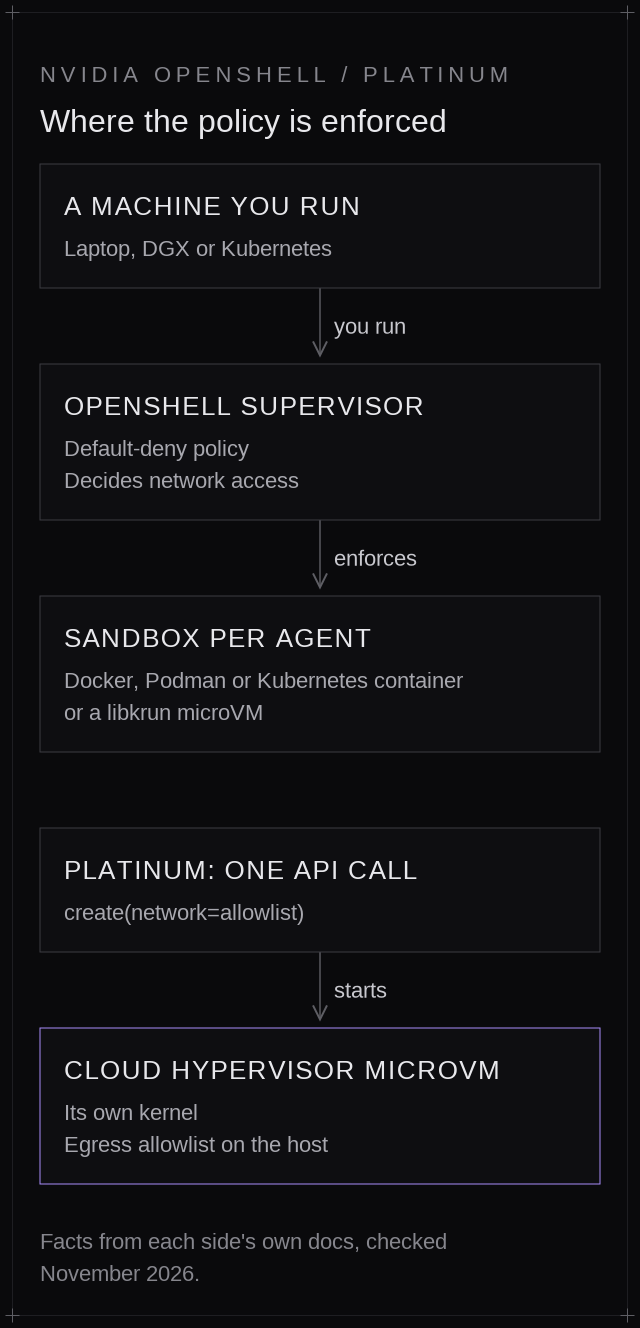
NVIDIA OpenShell is an Apache-2.0 runtime that puts AI agents behind a policy on infrastructure you operate: a laptop, a DGX or any Kubernetes cluster. Its alternatives differ less in policy than in where the sandbox runs and who operates it. Platinum is the hosted one: a Cloud Hypervisor microVM per agent, behind an API.
What NVIDIA OpenShell is#
The repository calls it "the safe, private runtime for fleets of autonomous AI agents". Its YAML policy denies whatever it does not allow: a supervisor outside the sandbox decides network access, and Landlock and seccomp confine files and system calls.
Network rules apply per binary and per HTTP method and path, and change at run time. Agents hold credential placeholders that a proxy resolves only at the endpoint they are bound to (providers). The sandbox is a Docker, Podman or Kubernetes container, or a libkrun microVM with its own kernel (runtimes).
It is pre-1.0, at v0.1.9 as of 20 November, and its move to the CNCF as a Sandbox project was announced on 10 November. NVIDIA offers no managed OpenShell service; a Brev Launchable starts a cloud machine you then run. The built-in runtime does not implement suspend and resume (backend).
Side by side#
| Option | Isolation | Runs on | Best for |
|---|---|---|---|
| Platinum | Cloud Hypervisor microVM | Hosted API | A sandbox per user or job, with no session deadline |
| Agent Substrate | gVisor, or Kata on Cloud Hypervisor | Your Kubernetes cluster | Many mostly idle agents in your own network |
| Docker Sandboxes | MicroVM | A developer's machine, or Docker's cloud | Coding agents on developer machines, with an optional cloud |
| E2B | Firecracker microVM | Hosted, or self-hosted | Hosted microVMs for coding, computer-use and RL agents |
| NVIDIA OpenShell | Container, or microVM (libkrun; QEMU for GPU) | Your laptop, DGX or Kubernetes | Per-binary policy on infrastructure you operate |
Facts are from each project's own pages, checked November 2026.
Platinum: hosted microVMs with an egress allowlist#
Each sandbox is a Cloud Hypervisor microVM with its own kernel, created with one API call. Outbound traffic is open unless you set a per-sandbox allowlist of hostnames and addresses with a default deny (networking). An org secret is written into requests to its allowed hosts by the egress proxy, and the sandbox receives nothing, not even a placeholder.
Platinum has no per-binary rules and no policy prover; OpenShell has both. This ran on production on 20 November:
from platinum import Platinum

PROBE = """python3 -c '
import urllib.request
for url in ["https://api.github.com/zen", "https://example.com/"]:
    try:
        print(url, urllib.request.urlopen(url, timeout=5).status)
    except Exception as e:
        print(url, "blocked:", type(e).__name__)
'"""

client = Platinum(token="pt_live_…", api_url="https://api.platinum.dev")
sbx = client.sandboxes.create(
    cpu=1, ram_mb=512, wait_for_running=True,
    network={"allow_out": ["api.github.com"], "deny_out": ["0.0.0.0/0"]},
)
print(sbx.sh(PROBE).stdout.strip())
print(sbx.stop(wait_for_stopped=True)["memory_saved"])
sbx.start(wait_for_running=True)
print(sbx.sh(PROBE).stdout.strip())
sbx.delete()https://api.github.com/zen 200
https://example.com/ blocked: URLError
True
https://api.github.com/zen 200
https://example.com/ blocked: URLErrorThe policy held through a stop that saved memory, and through the start after it.
Agent Substrate: Kubernetes you operate#
Google's runtime starts a gVisor sandbox (the default) or a Kata microVM on Cloud Hypervisor per agent, on a cluster you run. Egress is default-deny, agents never hold keys, snapshots capture memory, and mostly idle agents share a small pool of warm workers (repository). More in Agent Substrate, or a hosted microVM API.
Docker Sandboxes: agents on a developer's machine#
sbx runs each coding agent in a microVM on the developer's own hypervisor, free, and a host-side proxy keeps API keys out of the VM (docs). Docker's cloud also runs microVMs: they expire after an hour by default, extend to 24 hours, and can stop with memory kept (cloud usage). More in the Docker Sandboxes alternative.
E2B: hosted Firecracker with memory snapshots#
E2B runs Firecracker microVMs as a service. Its snapshots keep memory as well as files, so a new sandbox can start from another's running state (snapshots). Sessions last up to 1 hour on Hobby and 24 hours on Pro (pricing), and the code can be self-hosted.
Which one fits#
- NVIDIA OpenShell when agents run on infrastructure you operate, from a laptop to a Kubernetes cluster, and each binary needs its own rules.
- Platinum when you want a microVM per user or job from an API, with no session deadline and no cluster to run.
- Agent Substrate when many agents must run inside your own Kubernetes cluster.
- Docker Sandboxes when developers run coding agents on their own machines, with Docker's cloud for longer work.
- E2B when you want hosted Firecracker sandboxes you can fork from a memory snapshot, or self-host.